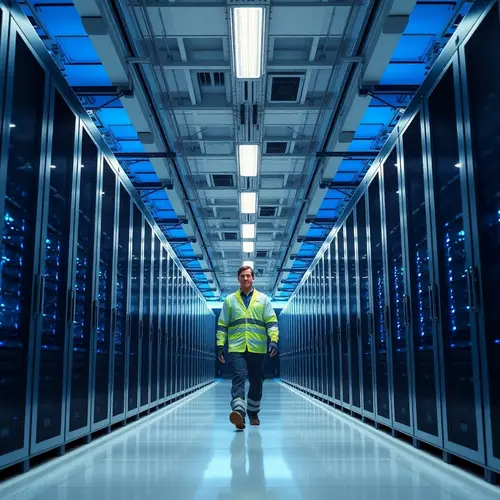
The physical infrastructure supporting modern digital services within a high-tech data center.
Starcloud Secures $170M Series A Funding at $1.1B Valuation
Starcloud, a leader in orbital data centers, has successfully closed a $170 million Series A funding round. This significant capital injection raises the company’s valuation to $1.1 billion. The substantial Starcloud Series A funding solidifies its position within the burgeoning space computing technology sector.
What Happened
The Redmond, WA-based company, Starcloud, secured $170 million in its Series A funding round. This investment places the Starcloud company valuation at $1.1 billion. The announcement comes just over two years after the company’s founding. The total funding was reportedly split into two distinct tranches.
Details From Sources
The initial funding round was led by Benchmark, with EQT Ventures also participating, according to Payloadspace.com. Benchmark and EQT co-led the extension tranche of the Series A funding. A diverse group of institutional participants joined the round, including Macquarie Capital, NFX, Nebular, Y Combinator, Adjacent, Seven Seven Six, Fuse Ventures, Manhattan West, and Monolith Power Systems (Payloadspace.com).
Angel investors also contributed to the round, notably Gen. Stephen Wilson, former Boeing CEO Dennis Muilenburg, and ex-Starbucks CEO Kevin Johnson (Payloadspace.com). Starcloud CEO Philip Johnston commented on the high demand for capital, stating, “We could have taken more capital if we wanted to” due to investor interest in orbital data center ventures (Payloadspace.com).
Starcloud launched its first spacecraft, Starcloud-1, to orbit in November. It was carried aboard the SpaceX Falcon 9 Bandwagon-4 rideshare mission (Payloadspace.com). Starcloud-1 notably brought an Nvidia H100 GPU to space for the first time. This achievement demonstrated the company’s ability to operate AI-enabled tech in the challenging space environment (Payloadspace.com).
Looking ahead, Starcloud-2 is scheduled for launch later this year. This second mission aims to achieve 100 times more power than its predecessor, Starcloud-1 (Payloadspace.com). Starcloud-2 will feature a deployable radiator, described as the largest ever in orbit (Payloadspace.0). It will also include an NVIDIA Blackwell chip, AWS Outposts hardware, and bitcoin-mining circuits (ASICs) (Payloadspace.com). Crusoe, AWS, Google Cloud, and NVIDIA are listed as customers and partners for Starcloud-2’s edge compute and cloud workloads (Payloadspace.com).
Why This Matters
This fundraise highlights strong investor demand for orbital data center ventures. Starcloud holds a unique position as a data center startup with proven flight heritage. This demonstrates significant progress in space computing technology.
Background Context
Starcloud was founded just over two years before its Series A funding announcement. The company operates from its base in Redmond, Washington.
Future Implications (SPECULATIVE)
- SPECULATIVE: Starcloud plans to use its new funds to establish a new manufacturing facility. This facility will produce Starcloud-3 spacecraft (Payloadspace.com).
- SPECULATIVE: Starcloud-3 spacecraft are intended for future commercial SpaceX Starship flights. CEO Philip Johnston expects these flights to commence by the end of 2028 (Payloadspace.com).
- SPECULATIVE: The company plans to expand its team considerably. It aims to grow from 13 to up to 50 employees by the end of the year (Payloadspace.com).
- SPECULATIVE: Starcloud intends to reduce costs by bringing much of its production processes in-house (Payloadspace.com).
- SPECULATIVE: CEO Johnston envisions multiple applications for orbital data centers. These include providing compute power for space-generated data and performing terrestrial data workloads in space for enhanced data security (Payloadspace.com). He also sees orbital data centers competing with terrestrial data centers for everyday tasks (Payloadspace.com).
- SPECULATIVE: Reduced launch costs are crucial for many in-orbit data center applications. Vehicles like Starship are necessary for certain applications to be financially viable (Payloadspace.com).
Conclusion
The successful Starcloud Series A funding round underscores investor confidence in orbital data centers. With a $1.1 billion Starcloud company valuation, the firm continues to advance its space computing technology. Starcloud aims to redefine data processing capabilities beyond Earth.
FAQs
Q1: What is Starcloud’s recent funding amount and valuation?
A1: Starcloud recently raised $170M in Series A funding, which values the company at $1.1B.
Q2: What technology did Starcloud’s first spacecraft, Starcloud-1, bring to orbit?
A2: Starcloud-1 brought an Nvidia H100 GPU to space for the first time, demonstrating the ability to keep AI-enabled technology operational in orbit.
Q3: What are Starcloud’s plans for its Starcloud-2 mission?
A3: Starcloud-2, scheduled for later this year, aims to generate 100 times more power than Starcloud-1 and will feature a deployable radiator, a Blackwell chip from NVIDIA, AWS Outposts hardware, and bitcoin-mining circuits (ASICs).
Q4: How does Starcloud plan to use its new Series A funds?
A4: Starcloud plans to use the funds to establish a new manufacturing facility for Starcloud-3 spacecraft, grow its team from 13 to up to 50 employees by year’s end, and reduce costs by bringing production in-house.
Q5: What are the envisioned applications for orbital data centers, according to CEO Philip Johnston?
A5: CEO Philip Johnston sees three applications: providing compute power for data generated in space, performing terrestrial data workloads in space for data security, and competing with terrestrial data centers for everyday tasks.