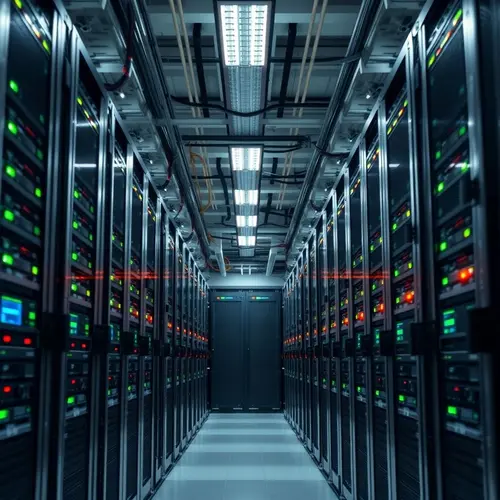
The robust infrastructure of a modern data center, powering the digital economy.
Memory Chip Focus: A Shifting AI Tech Investment Strategy
The artificial intelligence (AI) trade has grown more complex, becoming “more fraught.” A significant shift in AI tech investment strategy is underway. Investors are increasingly prioritizing companies that produce memory chips. This contrasts with the market’s response to big-spending tech giants and software companies. These larger entities have faced market punishment. Overall, 2026 has presented a challenging year for tech stocks.
What Happened in AI Tech Investment Strategy
Investors are clearly favoring companies that are “on the receiving end of big tech’s spending spree.” Specifically, investors are “betting on memory chips.” Concurrently, they are “punishing big-spending tech giants and software companies.” This trend is reported by the Wall Street Journal in its article, “Picks and Shovels Still Rule the AI Tech Trade.”
Details From Sources: Investor Preferences and Market Performance
Investor preference is for “picks and shovels” related to AI, such as memory chips. The market has reacted negatively to large tech companies perceived as “big-spending.” Generally, 2026 has been a “rough year in general for tech stocks.” According to the Wall Street Journal article “Picks and Shovels Still Rule the AI Tech Trade” by Dan Gallagher, specific market data illustrates this trend. The Nasdaq composite recorded a 1% loss by Friday’s close in 2026. Conversely, the Dow logged a 4% gain by Friday’s close in 2026. The S&P 500 Equal Weight Index is up around 5%. Meanwhile, the standard S&P 500 has seen a gain of about 1%. Eight tech giants’ combined market capitalization accounts for “more than a third” of the S&P 500’s total. The equal-weight index, however, “nullifies their outsize influence.” This market behavior aligns with discussions suggesting “It Really Is Possible to Spend Too Much on AI.”
Why This Shift in AI Tech Investment Strategy Matters
This market shift signals a strategic realignment in AI tech investment strategy. Focus is moving from end-user software or services. Instead, it prioritizes foundational hardware suppliers like memory chip companies. This trend reflects a market recalibration. It changes how AI-related spending and value are perceived. Concerns about spending too much on AI are influencing this outlook.
Background Context of AI Spending Trends
The current situation fits within the broader “AI tech trade” narrative. An underlying market sentiment exists regarding the possibility to “spend too much on AI.” This sentiment significantly influences investor decisions. It shapes preferences for specific AI hardware demand sectors.
Related Market Performance Data for 2026
- Nasdaq composite: 1% loss (by Friday’s close).
- Dow: 4% gain (by Friday’s close).
- S&P 500 Equal Weight Index: 5% gain.
- Standard S&P 500: 1% gain.
Eight tech giants collectively represent over one-third of the S&P 500’s total market capitalization. This concentration affects overall index performance.
Conclusion: A Cautious AI Tech Investment Strategy Emerges
Investors are adopting a more selective AI tech investment strategy. They are favoring critical hardware providers, such as memory chip companies. This trend highlights a cautious approach within the AI sector. It distinguishes between foundational support and the spending habits of larger tech entities.
Frequently Asked Questions
What is the current prevailing AI tech investment strategy?
Investors are currently prioritizing companies involved in memory chips and those on the receiving end of big tech’s spending spree, shifting away from big-spending tech giants and software companies.
How have tech stocks performed generally in 2026?
So far in 2026, tech stocks have generally experienced a rough year, with the Nasdaq composite logging a 1% loss by Friday’s close.
Why are memory chip companies gaining investor favor in the AI trade?
Investors are “betting on memory chips” as part of a “picks and shovels” approach, choosing these companies as beneficiaries of big tech’s spending on AI infrastructure.
How does the performance of the S&P 500 Equal Weight Index compare to the standard S&P 500?
The S&P 500 Equal Weight Index is up around 5%, while the standard S&P 500 is up around 1%, indicating that the outsized influence of eight tech giants in the standard index may be skewing its performance.