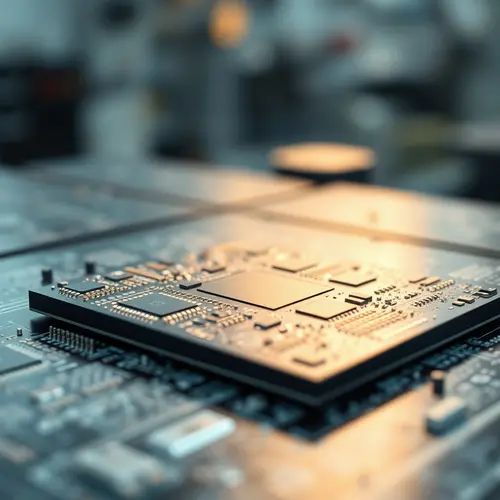
The foundation of modern technology: a silicon wafer with complex micro-circuitry.
India Revises Deep Tech Policy, Extends Startup Support to 20 Years
India has revised its startup regulations for deep tech companies. These changes extend the period during which these ventures are officially recognized as startups. The primary goal is to help more deep tech ventures mature into commercial products. This policy targets sectors like space, semiconductors, and biotech, addressing their typically longer development cycles. The updates represent a significant step in the India deep tech policy and its broader ecosystem.
What Happened
The Indian government has updated its startup framework for deep tech businesses. The period for which deep tech companies are treated as startups has now been doubled to 20 years. Additionally, the revenue threshold for startup-specific tax, grant, and regulatory benefits has increased. It is now ₹3 billion (approximately $33.12 million), up from ₹1 billion (around $11.04 million).
These revisions aim to align policy timelines with the long development cycles inherent in science- and engineering-led businesses. This forms a core part of the updated India deep tech policy. The government seeks to build a long-horizon deep tech ecosystem through these regulatory reforms.
Details From Sources
New Delhi is also mobilizing public capital for the deep tech sector. The ₹1 trillion (around $11 billion) Research, Development and Innovation Fund (RDI) was announced last year. This fund intends to expand patient financing for science-led and R&D-driven companies, as noted on the RDI Fund website. Alongside government efforts, a significant private initiative has emerged. The India Deep Tech Alliance, a $1 billion-plus private investor coalition, was launched by U.S. and Indian venture firms. These include Accel, Blume Ventures, Celesta Capital, Premji Invest, Ideaspring Capital, Qualcomm Ventures, and Kalaari Capital, with Nvidia acting as an adviser, according to TechCrunch.
Why This Matters
These policy changes are expected to address “artificial pressure points” by formally recognizing deep tech as distinct. Vishesh Rajaram, founding partner at Speciale Invest, stated that the policy reduces friction. This includes friction in fundraising, securing follow-on capital, and engaging with the state. The framework also aims to prevent the historical “graduation cliff” issue. Siddarth Pai of 3one4 Capital noted that companies previously lost support while still scaling.
Background Context
The RDI Fund, announced last year, is currently taking shape operationally. The first batch of fund managers has been identified. The selection process for venture and private equity managers is also underway. The RDI Fund is designed to be a nucleus for greater capital formation, rather than a traditional fund-of-funds. It is structured to take direct positions, provide credit, and offer grants to deep tech startups. India already possesses existing private capital for deep tech, particularly within the biotech sector.
Industry Reactions
Industry leaders have welcomed the updated India deep tech policy. Vishesh Rajaram of Speciale Invest believes the policy reduces friction for founders. Arun Kumar, managing partner at Celesta Capital, noted the RDI framework will increase funding and address follow-on funding gaps. Siddarth Pai, founding partner at 3one4 Capital, observed that the framework helps avoid a “graduation cliff” for scaling companies. Pratik Agarwal, a partner at Accel, sees the policy as a longer-term signal for global investors. He believes it increases confidence in India’s long-term view on deep tech. Neha Singh, co-founder of Tracxn, suggested that the pickup in funding indicates a gradual move toward longer-horizon investing.
Related Data or Statistics
Indian deep tech startups have raised a total of $8.54 billion to date. Recent momentum shows $1.65 billion raised in 2025. This marks a rebound from $1.1 billion in the previous two years, though it is below the $2 billion peak in 2022, according to Tracxn. Investor confidence is growing in areas such as advanced manufacturing, defence, climate technologies, and semiconductors. Comparatively, U.S. deep tech startups raised about $147 billion in 2025, while China accounted for roughly $81 billion, Tracxn data indicates. This disparity highlights India’s challenge in building capital-intensive technologies despite its engineering talent.
Future Implications (SPECULATIVE)
These government moves are hoped to lead to increased investor participation over the medium term. It remains to be seen whether this will reduce the tendency of Indian startups to shift their headquarters overseas as they scale. The extended runway strengthens the argument for building and staying in India. However, access to capital and customers will continue to be important factors. India’s public markets have shown a growing appetite for venture-backed tech companies over the past five years. This makes domestic listings a more credible option. Access to procurement and late-stage capital will still shape where companies ultimately scale. The ultimate test, according to Arun Kumar of Celesta Capital, will be whether India can deliver globally competitive outcomes, with a critical mass of Indian deep tech companies succeeding on the world stage serving as a benchmark.
Conclusion
India has significantly updated its deep tech policy, extending startup status to 20 years and raising revenue thresholds. These regulatory changes are supported by initiatives like the ₹1 trillion RDI Fund and the $1 billion-plus India Deep Tech Alliance. The goal is to foster a more robust and mature deep tech ecosystem India. These efforts aim to increase investor confidence and enhance global competitiveness for Indian deep tech ventures.
FAQ
Q1: What are the key changes in India’s deep tech policy for startups?
A1: The policy has doubled the period for deep tech companies to be treated as startups to 20 years. It also raised the revenue threshold for benefits to ₹3 billion (about $33.12 million).
Q2: Why did India revise its deep tech startup rules?
A2: The revisions aim to align policy timelines with the longer development cycles typical of science- and engineering-led businesses in deep tech sectors. They also seek to mobilize public capital to help these startups mature.
Q3: What is the Research, Development and Innovation Fund (RDI)?
A3: The RDI Fund is a ₹1 trillion (around $11 billion) fund announced by the Indian government last year. It is intended to expand patient financing for science-led and R&D-driven companies.
Q4: How has funding for Indian deep tech startups performed recently?
A4: Indian deep tech startups raised $1.65 billion in 2025, rebounding from $1.1 billion in the two prior years. This figure is lower than the $2 billion peak recorded in 2022.
Q5: What impact do these changes have on investor confidence?
A5: Investors view the framework change as a signal of longer-term policy intent. This increases confidence that the policy environment will support deep tech companies over their typically long development horizons.