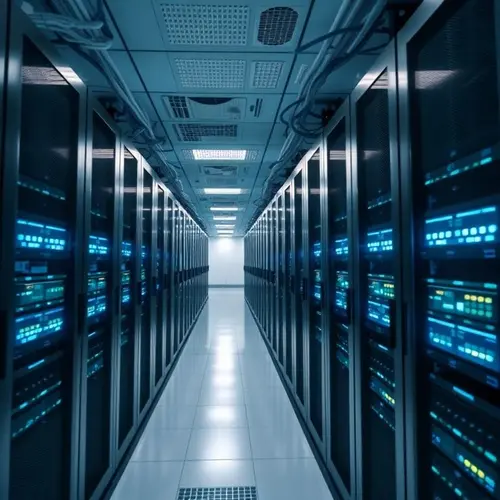
Inside a state-of-the-art data center, highlighting the physical infrastructure powering digital services.
Big Tech AI Investments Under Scrutiny Ahead of Earnings Season
The upcoming earnings season for major technology companies has arrived. Wall Street is scrutinizing significant big tech AI investments. Rising expectations for tangible returns on these substantial investments are now a central theme.
What Happened
Tech megacaps collectively spent billions on AI infrastructure in 2025. This spending was driven by massive demand for artificial intelligence capabilities. Wall Street anticipates another year of substantial spending from these companies in 2026.
Overall capital expenditure (capex) for hyperscalers—Microsoft, Meta, Alphabet, and Amazon—is projected to exceed $470 billion in 2026. This marks an increase from approximately $350 billion in 2025, according to FactSet. Investor sentiment reflects mounting AI bubble concerns and a demand for clear payoffs from these investments.
Details From Sources
Microsoft’s Big Tech AI Investments
Microsoft faces the challenge of demonstrating cost control in data center build-outs for AI demand and its Azure cloud. In October 2025, the company’s stock dropped after increased spending guidance. CFO Amy Hood stated that capex growth in 2026 would exceed 2025 levels.
Analyst expectations project Microsoft’s capex to reach $99 billion in the fiscal year ending June 2026, with further increases in subsequent years, per FactSet. Fiscal Q2 capex and finance leases consensus was $36.25 billion, representing a 60% year-over-year increase, according to Visible Alpha. The company predicted a flat year-over-year operating margin in October 2025. Analysts foresee 67%, which would be the narrowest in three years, Visible Alpha reported.
In November 2025, Microsoft announced a $5 billion investment in Anthropic as part of new Anthropic investments. Anthropic committed to using $30 billion in Azure compute capacity. Cloud infrastructure remains Microsoft’s primary growth area. Microsoft forecasted 37% revenue growth for Azure infrastructure and cloud services in the current period, a slight dip from 39% in the September quarter. KeyBanc analysts noted in January 2026 that over half of organizations license Microsoft 365 Copilot for up to 10% of users, and under 25% license it for up to 25% of users.
Meta’s Big Tech AI Investments
Meta’s revenue primarily stems from digital advertising, leading to investor questions about AI monetization. An AI strategy shift occurred after a failed launch of the Llama model. In June 2025, Meta made a $14.3 billion investment in Scale AI. The company increased its 2025 capital expenditures guidance to $70-$72 billion in October 2025, up from $66-$72 billion.
CEO Mark Zuckerberg expressed confidence in AI investments for future payoffs, driven by returns in the core business. FactSet analysts project nearly 57% capex growth in 2026 to over $110 billion. Goldman Sachs forecasts $125 billion for 2026, rising to $144 billion in 2027. Internally, Meta is developing a frontier AI model called “Avocado.”
Apple’s Big Tech AI Investments
Apple reached a high-profile agreement with Google to use Gemini models for a major Siri overhaul. The Siri revamp was delayed in spring 2025 due to longer-than-expected personalization feature development. Bank of America analysts suggested the Google deal could drive iPhone upgrades. Apple’s AI strategy is growing slower compared to rivals like OpenAI and Google.
Apple Intelligence launched in 2024, but faced issues. In January 2025, AI notification summaries for news were briefly disabled due to inaccuracies. The iPhone 17 launched in September 2025 to positive reviews. In October 2025, Apple expected 10% to 12% revenue growth in the current quarter. They also predicted double-digit iPhone revenue growth year over year. CEO Tim Cook stated in October 2025 that he predicted the “best ever” December quarter and “off the chart” reception for iPhone 17.
Amazon’s Big Tech AI Investments
In October 2025, Amazon upped its 2026 capex forecast to $125 billion from $118 billion. This is the highest among megacaps, driven by AI services demand. FactSet analysts forecast over 17% growth in 2026 to more than $146 billion. Amazon Web Services AI (AWS) is a leading cloud infrastructure provider. It faces pressure to articulate its AI strategy and compete with OpenAI, Google, and Anthropic.
AWS signed a $38 billion deal with OpenAI in November 2025. OpenAI will use AWS infrastructure with Nvidia chips, highlighting evolving OpenAI funding deals. CNBC reported in December 2025 about Amazon’s potential $10 billion investment in OpenAI. Amazon has long backed Anthropic, which recently raised a $10 billion funding round at a $350 billion valuation. Microsoft’s Azure has been growing faster than AWS. CEO Andy Jassy noted the AWS business is “gaining momentum,” particularly from AI workloads.
Alphabet’s Big Tech AI Investments
Alphabet had a significant spending year in 2025. It was also the best stock year since 2009 due to confidence in its Google AI strategy. In October 2025, Alphabet lifted its 2025 capex forecast to $91-$93 billion from $85 billion in July 2025 due to cloud demand. A “significant increase” in 2026 is expected. FactSet analysts expect over $115 billion in spending from Alphabet in 2026. Google has inked deals with both OpenAI and Anthropic.
A multibillion-dollar Google-Anthropic deal in October 2025 provides Anthropic access to up to 1 million Google’s tensor processing units by 2026. Google’s AI revival gained a boost from the Apple deal for a Siri overhaul, following OpenAI’s strong start with ChatGPT. Google pays billions annually to Apple as the default iPhone search engine. Investors will monitor continued search growth. They also seek assurances that AI is not negatively impacting the core business. OpenAI announced in January 2026 it would begin testing ads on ChatGPT in the U.S.
Tesla’s Big Tech AI Investments
Tesla’s story differs from other peers due to Elon Musk’s “sustainable abundance” vision. Automotive deliveries fell 8.6% in 2025 to 1.64 million from 1.79 million in 2024. The energy unit grew last year, supporting Musk’s AI company, xAI. Investors are watching for potential board investment in xAI.
A Robotaxi ride-hailing service launched in 2025. Optimus humanoid robots are not yet for sale. Shares slumped last quarter after Musk focused on Optimus and Robotaxi efforts, not auto segment fundamentals. Investors are monitoring planned capex for chip technology for future autos and robotics. Musk stated in November 2025 that the company would proceed with new chip production with Samsung and Taiwan Semiconductor Manufacturing. FactSet analysts expect capex to grow to $11 billion in 2026 from projected $9.5 billion in 2025.
Why This Matters
Investor concerns about an “AI bubble” are growing. Companies must demonstrate how substantial AI investments will lead to profitability.
Conclusion
Heightened scrutiny on big tech AI investments continues as earnings season unfolds. Tech giants need to justify their significant spending with tangible returns for investors.
Stay informed on how big tech AI investments are shaping the market. Subscribe to our newsletter for the latest updates.
FAQ Section
Q: Which Big Tech companies are reporting earnings this week regarding AI spending?
A: Apple, Meta Platforms, Microsoft, and Tesla are scheduled to report earnings this week.
Q: What are the projected capital expenditures for hyperscalers in 2026?
A: Analysts estimate Microsoft, Meta, Alphabet, and Amazon will boost capital expenditures to over $470 billion in 2026, up from approximately $350 billion in 2025.
Q: What are investors concerned about regarding Big Tech’s AI investments?
A: Investors are concerned about mounting AI bubble worries and are anxious for clear signs of a payoff from the significant investments.
Q: How is Meta’s AI investment strategy impacting its financial outlook?
A: Meta’s stock dropped after it lifted its 2025 spending forecast, with investors concerned about potential losses given its reliance on digital advertising and lack of a cloud computing business.
Q: What is Apple’s strategy to enhance its AI capabilities?
A: Apple has a deal with Google to use its Gemini models for a major overhaul of its Siri voice assistant.
Source: CNBC